
The best air purifier for a home with pets is the one that fits your room, your cleaning routine and the features you will actually use. Start with room size and airflow, then compare particle filtration, carbon media, filter maintenance and controls.
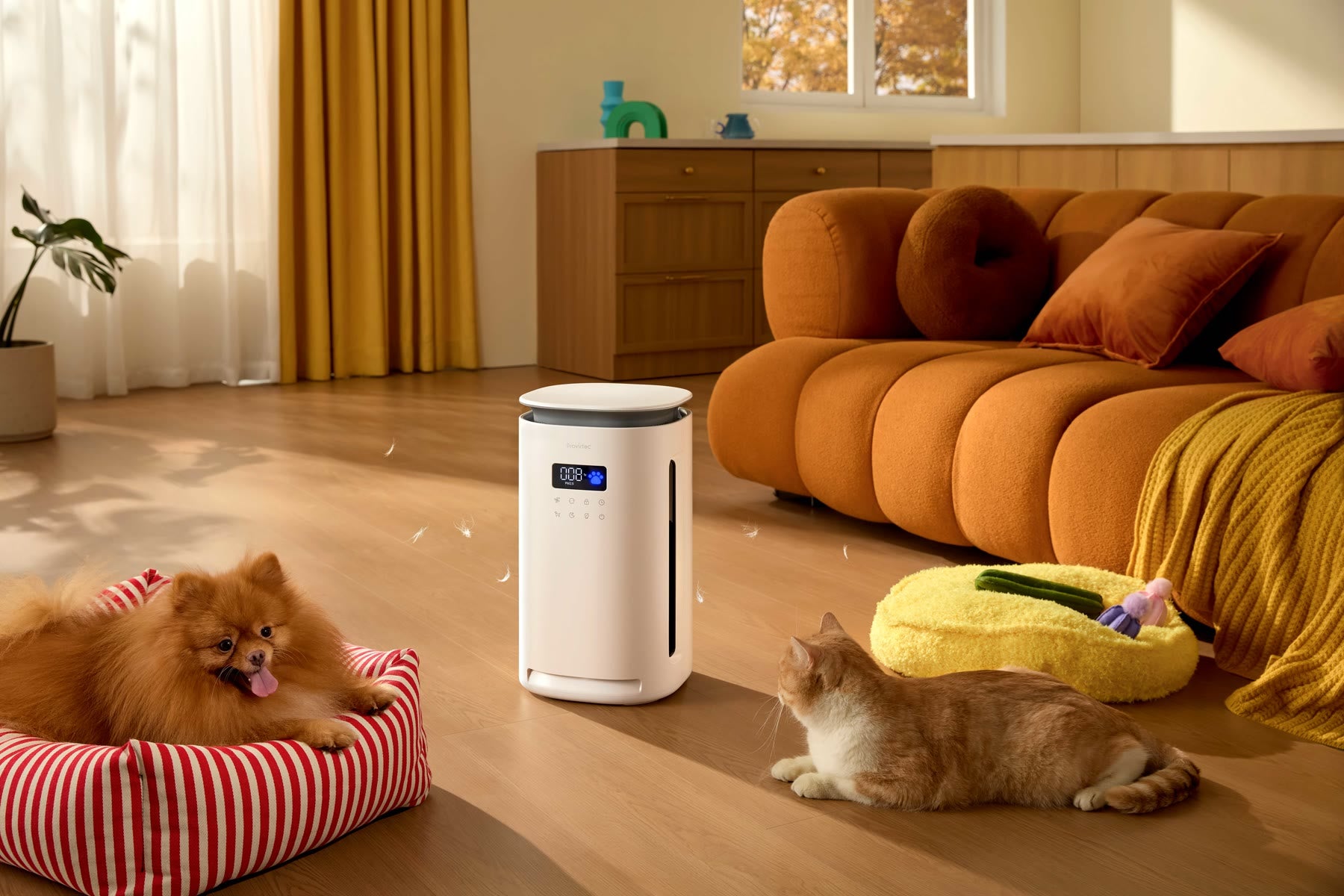
1. Match the purifier to your room
Measure the room where the purifier will run, rather than choosing from the total size of your home. Compare clean air delivery rate (CADR) using the same units, and check the conditions behind any room-coverage claim. An open doorway, ceiling height and the fan setting you use can affect performance.
Noise also matters: choose a setting you can comfortably leave running. A bedroom and a busy living room may call for different priorities.
2. Understand hair, particles and odors
- Floating pet hair: A pre-filter can intercept larger airborne hair and dust that reach the air intake. A purifier does not pick up fur that has settled on your sofa or floor; keep vacuuming and washing pet bedding.
- Fine particles and dander: Look at the complete filtration system and airflow. A filter-grade label alone is not a whole-room removal guarantee.
- Pet odors: Particle filters and gas-filtering media do different jobs. Activated carbon is used for some gases and odors, but results depend on the media, conditions and pollutant. Keep up with litter-box cleaning and other odor-source control.
The U.S. EPA's guide to air cleaners recommends selecting adequate CADR for particle filtration and appropriate gas-filtering media when needed. Air cleaning supplements source control and suitable ventilation; no purifier removes every pollutant or guarantees relief from allergies.
3. Choose a maintenance routine you can keep
A washable pre-filter can make routine hair removal easier, but a washable outer layer does not mean the HEPA or carbon assembly is washable. Check exactly which component can be rinsed, how to remove it and when replacement is needed.
Compare the price and availability of compatible replacement filters before buying. Included spare pre-filters can help you rotate a clean, fully dry one into use while another dries. They do not guarantee a fixed lifespan for the main filter.
Read how to clean your air filter safely before washing any component.
4. Compare the Pawtent range
This is a guide from Provirtec to choosing within the Pawtent range, rather than an independent ranking of every brand. The following specifications are the current published product details.
- Pawtent: 250 m³/h CADR, recommended room range 320–430 sq ft, PM2.5 sensing and on-device controls. A starting point for everyday use without connected features.
- Pawtent Pro: 320 m³/h CADR, recommended room range 430–650 sq ft and four included washable pre-filters. Consider it when you want more airflow and spare pre-filters for rotation.
- Pawtent Ultra: 500 m³/h CADR, recommended room range 650–860 sq ft, PM2.5 and odor/VOC sensing, plus App and compatible voice controls. Consider it for larger rooms and connected control.
Sensing tracks changes in air conditions; it does not identify a specific allergen or odor source, or establish a removal rate. For the full feature list, compare all Pawtent models.
Before you buy: a short checklist
- Confirm room fit and CADR.
- Check noise and controls for your daily routine.
- Identify which pre-filter is washable and check replacement compatibility.
- Verify any child-lock or tip-protection feature for the exact model.
- Plan a stable position with clear air inlets and protected cord routing.
Ready to choose? Explore a pet air purifier with a washable pre-filter, or shop the full pet air purifier range.